In class, one child answers in fluent English, and a child from a Hindi-medium background quietly lowers their head: "Will I fall behind?" Every such child should know the story of Jagadish Chandra Bose.
His schooling began in his mother tongue at a village pathshala. That same boy went on to demonstrate his experiments to scientists in London.
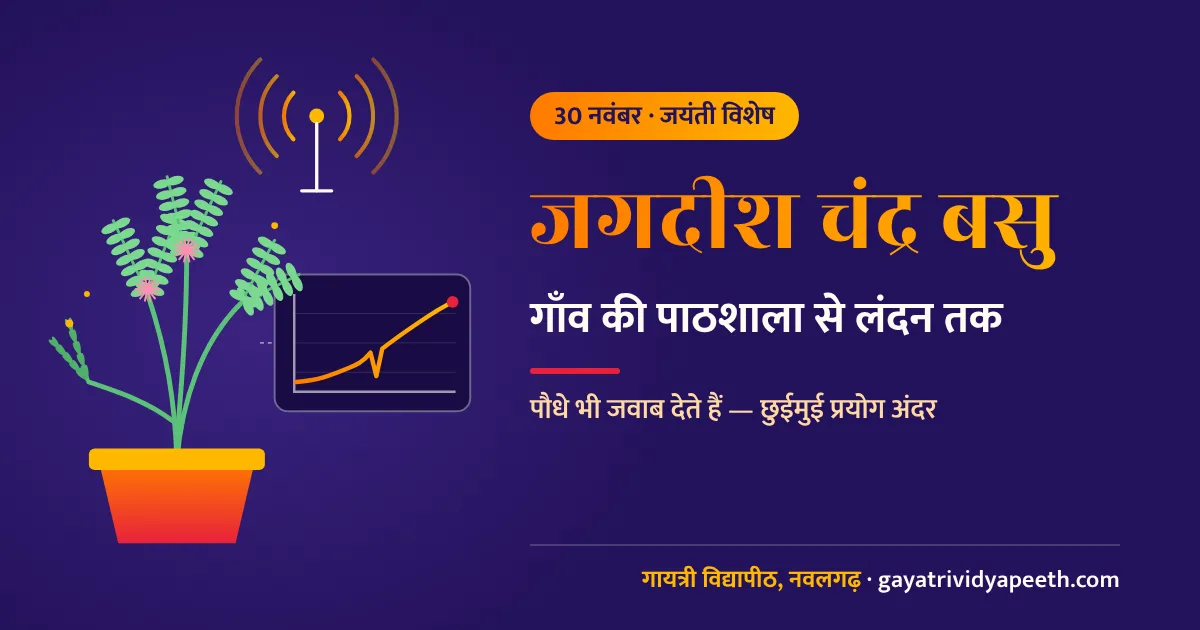
At the end of this 6-minute story there is an easy plant experiment children can try at home, and three small habits for parents. And on 15 November (Sunday), a quiz based on this story will go live.
Jagadish Chandra Bose's Childhood: A Bengali Pathshala With Farmers' and Fishermen's Children
Jagadish Chandra Bose was born on 30 November 1858 in Mymensingh, which is now in Bangladesh.
His father sent him not to an English school but to his own Bengali pathshala in Faridpur. His classmates there were the children of farmers and fishermen.
His father wanted him to know his own language and his own people before English. Amid talk of fields, rivers and fishing nets, nature became his biggest book.
Medicine Lost, Cambridge Gained: How Illness Changed His Path
After the village pathshala, Jagadish studied at St. Xavier's in Calcutta. Then he went to England to study medicine.
But ill health forced him to give up medical studies. He changed course, earned a BA from Christ's College, Cambridge, in 1884, and returned to India to teach physics.
He had started in his own language, yet in the English-speaking world he was not left behind.
Thirty Years at Presidency College: A Quiet Protest Against Unequal Pay
In 1885, Bose became professor of physics at Presidency College, Calcutta. He taught there until 1915, a full thirty years.
It is said that he was offered lower pay than European professors. In protest, he refused to accept his salary for about three years, while continuing to teach.
He was later made permanent and given his full back pay. In these same years began the work that would take him to London.
One Small Room, One Tinsmith, and Radio Waves 5 Millimetres Long
Bose built his first scientific instrument in a small room. He was helped by a local tinsmith who had no training for this kind of work.
With such simple means, he produced waves about 5 millimetres long. These are very short radio waves, called microwaves.
In 1895, in Calcutta, he demonstrated wireless signals sent over a distance of more than 23 metres. It may sound short today, but sending signals without wires was very new then. Today, mobile phones and Wi-Fi also run on radio waves and microwaves.
In January 1897, he lectured on and demonstrated his experiments at the Royal Institution in London. This is why he is counted among the early pioneers of radio and microwave science.
But his curiosity had also turned in a completely new direction: do trees and plants also respond to the things around them?
Plants Respond Too: From the Crescograph to the Bose Institute
The answer was yes. Through his experiments, Bose showed that plants respond to things like touch, light and heat. In 1902, he published his book on responses in living and non-living things.
A plant's growth and movement are so slow that our eyes cannot see them. To measure them, he designed the crescograph, which could record extremely tiny growth and movements in plants.
In 1904, he also received a US patent for a detector of radio signals. He was the first Asian to receive one.
He was knighted in 1916, and on 30 November 1917, his own birthday, he founded the Bose Institute in Calcutta. He called it not merely a laboratory but a temple.
In 1920, he was elected a Fellow of the Royal Society. He died in Giridih on 23 November 1937.
To learn more about his life and work, see the Bose Institute's founder page.
Try It at Home: A Touch-Me-Not Experiment for Children, 3 Habits for Parents
For Children: Observe Like Bose
Bose recorded plant movements with an instrument. You can see a touch-me-not's movement with your own eyes. Allow about 20–30 minutes, because the leaf takes time to reopen.
- Find a touch-me-not (chhuimui, or lajwanti) plant in a pot at home or a nearby garden.
- Gently touch one leaf with your finger. Watch how quickly the leaflets fold.
- Check a clock and note how many minutes the leaf takes to open again.
- In a notebook, write the date, the time and what you saw.
A mini-study for Classes 11–12: repeat the experiment 3 times and record the reopening time in a table each time. Then draw a simple bar graph, and compare what changes when you touch just one small leaflet versus the whole leaf.
This is the method scientists use: observe, measure, compare.
Take care: younger children should do this with an adult. Do not pluck the plant, do not keep disturbing it, and do not put any part of it in your mouth. The stem may have small thorns, so touch gently and wash your hands afterwards.
If you cannot find a touch-me-not, place a pot with a sprouting seedling near a window. For 3–4 days, check every day and note which way the seedling bends.
Quick self-check: Which instrument did Bose design to measure tiny plant growth? And on what special day did he found the Bose Institute?
For Parents: 3 Small Habits That Grow Curiosity and Self-Respect
- One "why" a day: at mealtime, ask your child what they noticed today that made them wonder. If you don't know the answer, find it out together.
- Talk freely in your own language: tell stories at home in Hindi or Rajasthani. A child at ease in their own language learns another one more easily.
- Make things with little: let your child build something from old boxes, cardboard and rubber bands. Praise the effort, not just the marks.
If the interest grows deeper, our Career Compass can help with choosing a stream after Class 10.
3 Questions About Bose, Answered Simply
Can a Hindi-medium child also go far in science?
Yes. Build strong science concepts in your own language, and practise a little English every day alongside, such as keeping a short list of science terms.
Which classes is the touch-me-not activity for?
All ages. Classes 6–8 can observe and write, Classes 9–10 can also time it, and Classes 11–12 can do the mini-study with a table, a graph and a comparison.
What can we do at home or school on Bose's birth anniversary (30 November)?
Two easy ideas: use this article to make a timeline poster of Bose's life, date by date. And do the touch-me-not activity, then compare your results with friends or classmates.
On 15 November (Sunday), a new quiz based on this story will go live in our Quiz Zone: 10 questions, and a certificate in your name when you finish. If you have read the story carefully, you will know the answers. Until then, share this story with another parent or child.
Gayatri Vidyapeeth, Nawalgarh: sanskar and success together. Vidya Dadati Vinayam.